
Podcast: Choosing the Right LLM for Your Business - 10Pearls

By 10Pearls editorial team

A global team of technologists, strategists, and creatives dedicated to delivering the forefront of innovation. Stay informed with our latest updates and trends in advanced technology, healthcare, fintech, and beyond. Discover insightful perspectives that shape the future of industries worldwide.

Podcast: Navigating the LLM Landscape and Choosing the Right Model

This podcast explores critical business considerations when opting for an open-source or proprietary large language model (LLM). Some key technical factors include performance speed and accuracy, as well as model capabilities, like size and context length.  

Additional factors such as usage rights, subscription costs, tokens, maintenance, and data privacy are also important. This discussion provides a detailed cost-benefit analysis of both open-source and proprietary LLMs. The choice ultimately hinges on weighing a number of factors, such as a business’ unique requirements, risk aversion, budget, and other available resources. 

Choosing the Right LLM for Your Business

00:00 / 00:00
Disclaimer:
This podcast has been AI-generated based on content from our blog. While we strive for accuracy, the information presented is intended for informational purposes only and may not fully capture the nuances of the original blog post. Please refer to the written content for the most accurate and comprehensive details.

Key considerations for LLM selection

In this podcast, 10Pearls has highlighted the following key factors to consider when choosing an LLM:

Performance

Performance can be gauged broadly in two categories: speed and precision.

  • Inference speed
    Speed determines how quickly an LLM processes information and provides an output. This is especially important for chatbots, where immediate turnaround is expected.
  • Precision
    While speed is one of the most important aspects of an LLM, precision is equally important. There’s no use in getting quick responses if they’re factually incorrect.

Model dimensions

Model dimension can be explained as a model’s brain power and memory, which can be gauged by a model’s size and context length. speed and precision.

  • Context length
    Context length can be defined as a model’s short-term memory. It defines how much a model can retain and reference information. Larger context length requires a model to “remember” and have contextually relevant conversations.
  • Model size
    This can be measured in billions of parameters and is a generic indicator of a model’s complexity and capability. Larger models tend to be more sophisticated, with the ability to process billions of data points within training a model.

Usage rights

These are the licensing terms and restrictions for using and modifying a model. Proprietary LLMs provide robust infrastructure and restrictive terms of service, with less flexibility for customization. In contrast, open-source models offer greater flexibility and added maintenance and security responsibilities.

Cost

Cost encompasses both the upfront and ongoing expenses associated with an LLM. Businesses should evaluate these costs in the context of their budget and long-term scalability requirements.

  • Direct costs
    Subscription fees or usage-based pricing for paid models are direct costs. While the cost per token starts at an affordable rate, it can add up quickly with higher volumes of tokens used.
  • Indirect costs
    While an open-source model does not have a subscription fee, other indirect costs, such as infrastructure, customization, and maintenance expenses, must be considered.

Scalability

This comes down to an LLM’s ability to handle an increasing user load and demand. While open-source models can be customized to offer tailored solutions for your business, paid models often offer better scalability due to cloud infrastructure.

Data privacy

While open-source models are bound by legalities related to data privacy, they will have access to your data. While developing a personalized open-source model allows hosting it on private servers for greater data control, it requires a robust infrastructure and could be costly.

Key takeaways:
  • Performance: Balance speed (fast outputs) and precision (accuracy).
  • Model dimensions: Larger models handle more data, context length enables better memory.
  • Usage rights: Proprietary models offer reliability, open-source allow customization but need maintenance.
  • Costs: Proprietary models have subscription fees, open-source requires infrastructure investment.
  • Scalability: Proprietary models scale easily, open-source needs customization for growth.
  • Data privacy: Open-source enables private hosting, proprietary models manage data differently.
  • Business fit: Choose based on needs, budget, and risk tolerance.

Related articles

Top AI-Powered Software Testing Companies

AI/ML


Top AI-Powered Software Testing Companies

Compare the top AI-powered software testing services and learn how automation, self-healing tests, and AI-augmented QA de-risk enterprise releases.

Why AI-Powered QA Still Needs Human Judgement

AI/ML


Why AI-Powered QA Still Needs Human Judgement

AI is helping QA teams move faster, generating test cases, healing broken automation, and flagging risk before it becomes a problem. But faster testing isn't the same as safer testing. Here's why quality engineering still...

How AI Is Changing Software Engineering Roles

AI/ML


How AI Is Changing Software Engineering Roles

AI is changing what makes software engineers valuable. Learn why business context, architecture, and problem-solving matter more than ever in the age of AI.

Corporate AI Implementation Failure – Role of Leadership

AI/ML


Corporate AI Implementation Failure – Role of Leadership

Most enterprises now share the same models and tools, so why does AI still fail? The gap is leadership: prioritization, ownership, and governance, not better technology.
AI Skill Erosion – The Hidden Cost of AI Dependency

AI/ML


AI Skill Erosion – The Hidden Cost of AI Dependency

As AI adoption accelerates, enterprises face a hidden challenge: skill erosion. Learn how governance, oversight, and human judgment prevent thinkslop.

How AI creates value with open banking data

AI/ML


How AI creates value with open banking data

Every fintech company with an open banking license in Saudi Arabia must build the basic infrastructure to receive open banking data. With the right data enrichment layers built into this architecture and integrated into the...

Outcome Based Pricing in Digital Engineering

AI/ML


Outcome Based Pricing in Digital Engineering

AI is making outcome-based pricing more viable, but success still depends on clear metrics, shared accountability, and disciplined execution.

The Hidden Risk Behind AI-Powered Software Development

AI/ML


The Hidden Risk Behind AI-Powered Software Development

AI coding tools are accelerating development, but code review, governance, and quality assurance aren't keeping pace. Learn how enterprises can scale AI development responsibly.
Not All DevOps Partners Are Ready for AI, Here’s How to Tell the Difference

AI/ML


Not All DevOps Partners Are Ready for AI, Here’s How to Tell the Difference

Enterprises poured billions into GenAI, yet 95% see zero return. The gap isn't tooling, it's an AI-ready DevOps partner. Here are 6 questions and the red flags to watch for.
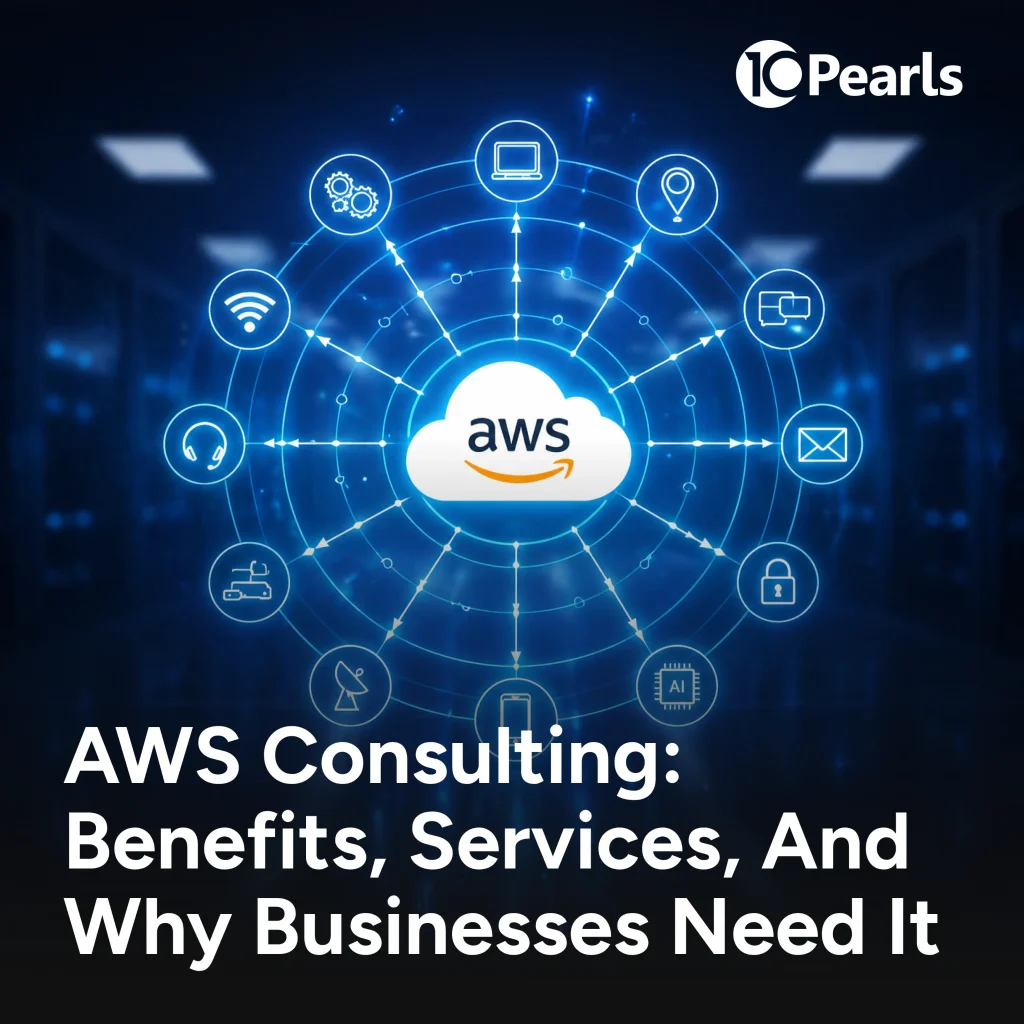
AWS Consulting: Benefits, Services, and How It Works

AI/ML


AWS Consulting: Benefits, Services, and How It Works

Learn why global enterprises are migrating to AWS. This blog explains how AWS consulting services help design scalable cloud solutions that optimize cost and performance.

Exelon Recognizes 10Pearls for Advancing Inclusivity in Business Practices
10p-logo-get-in-touch

Get in touch with us

Global digital transformation and product engineering partner
Privacy Overview
10Pearls Logo

This website uses cookies so that we can provide you with the best user experience possible. Cookie information is stored in your browser and performs functions such as recognising you when you return to our website and helping our team to understand which sections of the website you find most interesting and useful.

Strictly necessary cookies

Strictly necessary cookies should be enabled at all times so that we can save your preferences for cookie settings.

Third-party cookies

This website uses third party tools such as Google Analytics to collect anonymous information such as the number of visitors to the site, and the most popular pages.

Keeping this cookie enabled helps us to improve our website.